
AI and game dev · · 6 min read
AI tools for game development: where they help and where they fail
AI tools for game development, task by task: code, tests, text, art and audio. Where they save time, where they fail, and how to check what they give you.
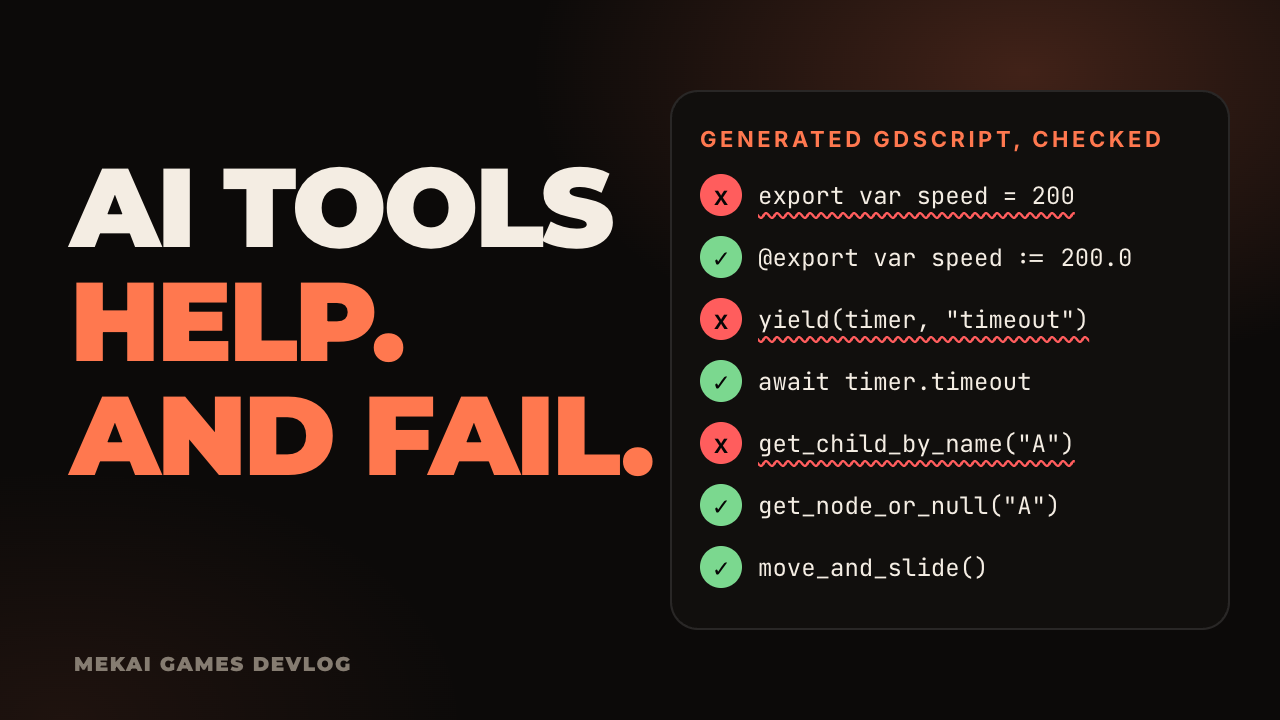
Is AI useful for game development?
Yes for small, checkable jobs: boilerplate code, test ideas, rough text, placeholder content. No for anything you cannot verify yourself or that ships to players with legal weight, such as final art, audio licences, save formats or legal wording. The same tool can be good at the first group and bad at the second in the same afternoon.
This guide sorts the common game dev tasks by one question: how quickly can you tell that the output is wrong? That decides how much time the tool saves you, more than which tool you pick. It names no products, because the rules below hold for any text or image generator.
Everything here is general advice for you as a developer. The one hard fact is Steam's disclosure rule, covered near the end and in the Steam AI disclosure guide.
What should you use it for in code?
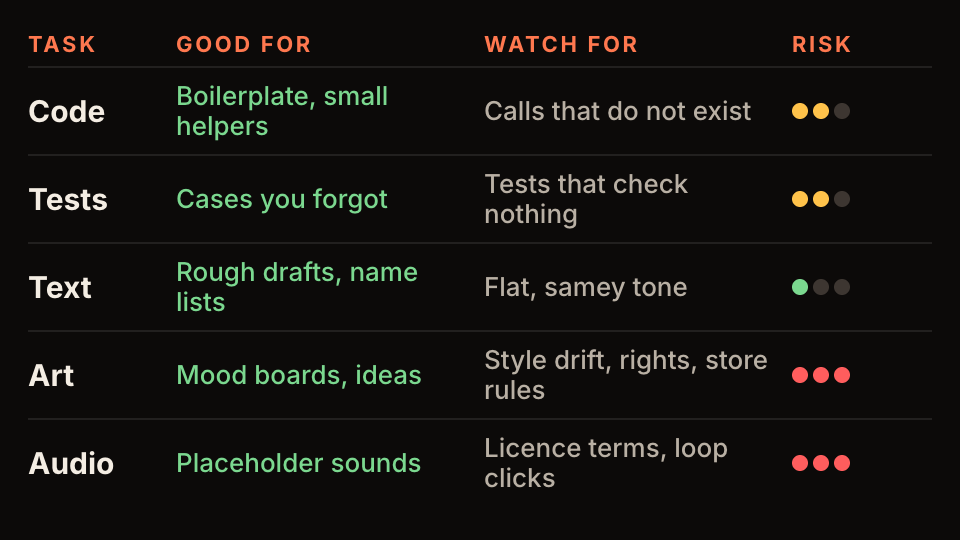
Use it for code where a wrong answer fails loudly and fast: a helper function, a data class, a loop you can run in 10 seconds, a regular expression you can test against 5 inputs. If the code is wrong, you see an error or a wrong number right away, and you lose a minute.
It fails in three ways. It calls functions that do not exist, it writes for an older version of your engine, and it writes code that runs but does the wrong thing. The first two are caught by the engine. The third is the expensive one, and it is the reason to read every line. A common example in Godot: multiplying velocity by delta before move_and_slide(). It runs without an error and the character crawls. The full list of Godot cases, tested in 4.5.1, is in the GDScript guide.
Do not hand it code that touches saves, purchases or anything that deletes data without reading it line by line. A bug there appears weeks later, on a player's device, with no error on your side. When it goes wrong, report the bug with the right context instead of pasting "it does not work".
Can AI write tests and review your code?
It is good at listing cases you forgot: an empty inventory, a negative price, two events in the same frame, a save file from the last version. Ask for a list of cases first, then write the tests yourself or review each one.
The failure to watch is a test that passes and checks nothing. It asserts something that is always true, or it copies the logic of the function it tests, so a bug in the function is also in the test. Break the function on purpose and see whether the test fails. If it does not, the test is decoration.
As a reviewer it gives plausible comments, some right and some invented. Treat each comment as a question to check, not a finding.
Is it safe for text, art and audio?
Text is the lowest risk, because you can read all of it. Names, item descriptions, tutorial drafts and store page copy are fine as first drafts. Expect flat, repeated phrasing, and expect to edit. Store text with claims in it (features, platforms, awards) must be checked against your actual game.
Art and audio are different, for three reasons. Style drifts from image to image, so a set of 40 icons will not match. You often cannot tell what the output was trained on, so rights are unclear (see the AI art copyright guide for that question). And stores ask about it.
Placeholder use is the safe end of that range: a rough sound to test a mix, a mood image for a pitch. The risk starts when a placeholder quietly becomes the shipped file. If you use generated content that players see or hear, plan for the disclosure form before launch, not after a rejection.
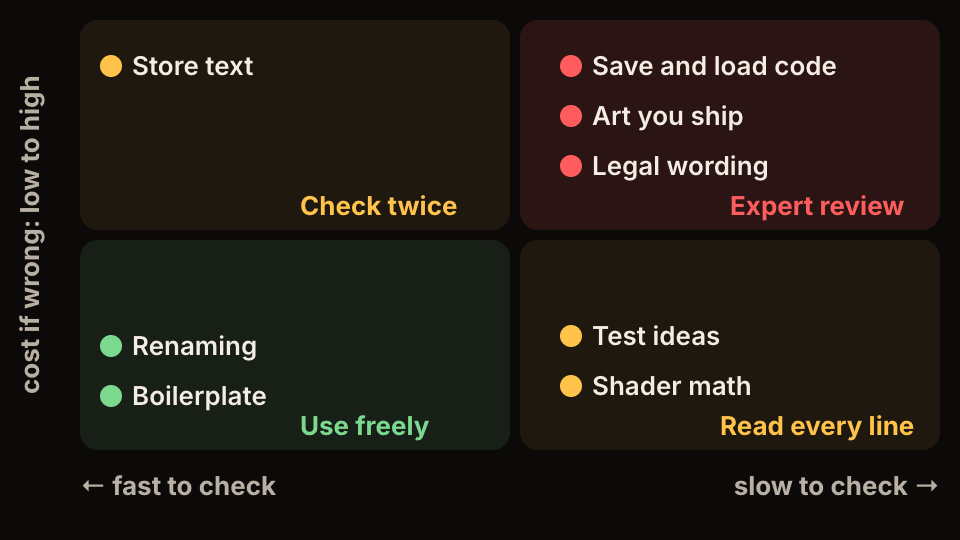
How do you decide when to trust the output?
Put each task in one of three groups by how you can check it. If you can run it and the result is obvious, use the output and move on. If you must read it to follow it, read it fully and treat it as a draft. If you cannot judge it alone, such as a save format, a licence or a legal clause, do not use the output as an answer. Use it to prepare better questions for someone who can.
Two habits make this cheaper. Keep requests small, because 20 lines are easier to check than 400. And ask for the reasoning behind a choice, then check the reasoning against the official documentation. A confident explanation is not evidence.
Does Steam require you to disclose AI?
Sometimes. As of November 2026, Valve's Content Survey asks about AI-generated content that ships in your game and is consumed by players, such as art, sound, narrative and localization, and about content a game generates live while running. Valve's page says efficiency gains from AI tools are not the focus of that section, so a code assistant that helped you write scripts is not what the form is about.
The rule has changed since it was introduced, and Valve's page does not list every edge case. Read the full breakdown of the Steam AI disclosure rules before you fill the form, and check the official page again close to release.
What is the plan for a small team?
- Pick one or two jobs from the "run it" lane and use the tool only there for a week.
- Keep a note of every wrong output you catch. After a week you know what to stop asking for.
- Never ship a file you cannot explain: a script you did not read, an image whose source you do not know.
- Write down which generated content ships to players, so the store forms are easy to fill later.
- Scope first. A tool will not rescue a project that is too big, so read how to scope a game you can finish before you add a tool to it.
Questions people ask
- Which parts of game development are safest to hand to AI?
- Small tasks that fail loudly or that you can read fully: boilerplate code, test case ideas, name lists and first drafts of text. Avoid it for save formats, purchases, legal text and final art or audio.
- Do I have to tell Steam I used an AI coding assistant?
- Valve's Content Survey page says efficiency gains from AI tools are not the focus of its AI section, which is about content players consume. Read the current page before release, because the rules have changed before.
- Will AI make a game for me?
- Not in a way you can ship without work. It produces pieces that you must check, fit together and finish. Scope still decides whether the game gets done.