AI and game dev · · 7 min read
AI art and copyright in games: what is settled and what is not
What the U.S. Copyright Office and courts, the EU AI Act, Steam, itch.io and Google Play say about AI-generated game art in November 2026. Not legal advice.
Can you copyright AI-generated game art?
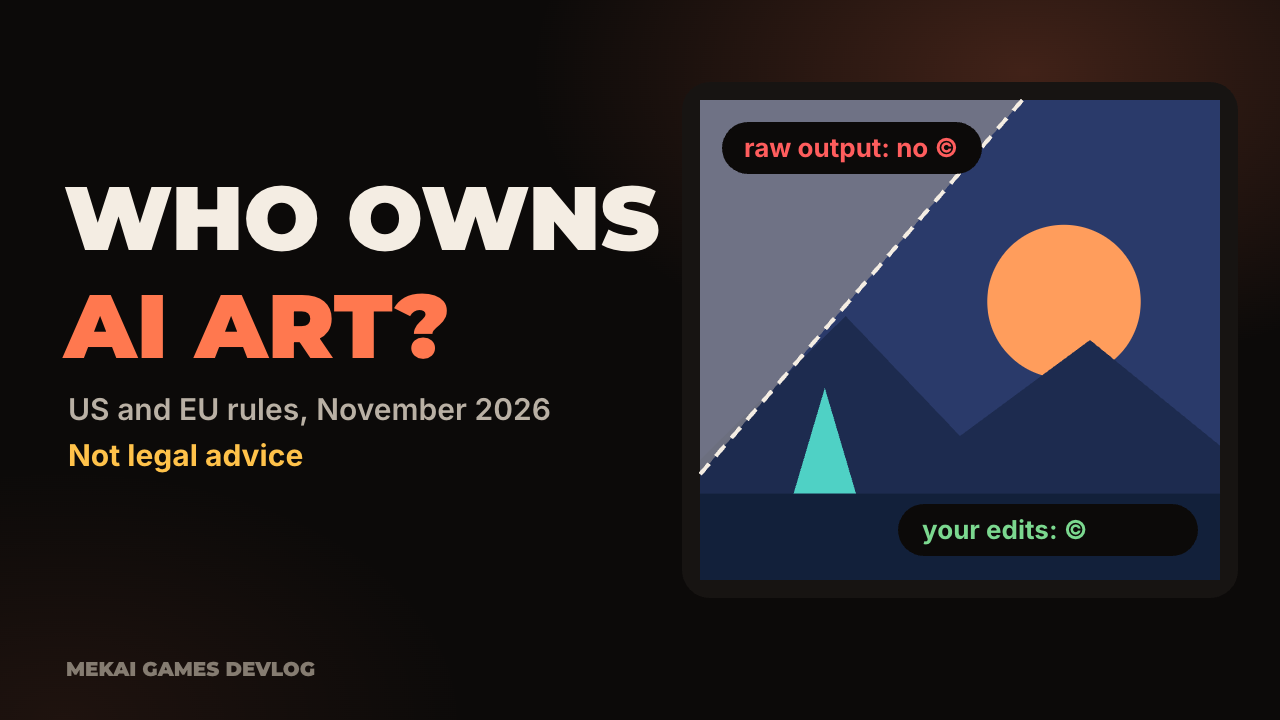
In the United States, art that an AI system generated on its own cannot be copyrighted. The parts that a person made can. That is the short answer, and it comes with a large warning: this is a guide to what official sources say, not legal advice, and the law is changing. If a lot of money or your main character depends on it, talk to a lawyer who handles copyright.
Everything below is as of 8 November 2026, and each rule links to the document it comes from. The picture is uneven. One question has a court answer in the U.S.: a machine cannot be the author. Several have an official position from the Copyright Office, which is guidance, not law. Others are open, including whether training on copyrighted work is fair use and who owns AI output under EU law.
What has the U.S. Copyright Office said?
The Office's report on copyrightability, published 29 January 2025, makes these points. Copyright protects the original expression a human author contributes, even if the work also contains AI-generated material. It does not extend to purely AI-generated material, or to material where a human did not control the expressive elements. Whether a person's contribution is enough is decided case by case.
On prompts specifically, the report says that with current generally available tools, prompts alone do not provide sufficient control to make the user the author, because prompts work as instructions that convey ideas, not expression. What a person can claim is their own work that shows up in the output, the creative selection, coordination or arrangement of material, and creative modifications.
For a game, one example in the report matters. A film that includes AI-generated effects or background art can be copyrighted as a whole, even if those effects and art are not protected on their own. The same logic suggests the game as a whole can be, while a raw AI sprite taken alone may not be. That last step is an inference from the report, not a ruling. Read the full Part 2 report.
The Office's earlier 2023 registration guidance, which the report summarizes, asks applicants to disclose AI-generated material that is more than minimal and to describe their own contribution.
What did the courts decide?
In Thaler v. Perlmutter, the D.C. Circuit held on 18 March 2025 that the Copyright Act requires a work to be authored in the first instance by a human being. The applicant had listed an AI system as the sole author. The court wrote that the rule does not stop people from copyrighting work made with the assistance of AI; it requires that the author be the person who used the AI, not the machine. The Supreme Court declined to hear the case on 2 March 2026, according to its docket. A denial is not a ruling on the merits, so the D.C. Circuit's decision stands and no nationwide ruling exists.
The case does not say how much human input counts as authorship, because the applicant claimed none. That is the part that is still open.
Training is a separate question. The Office's Part 3 report, released in pre-publication form on 9 May 2025 and still listed that way on its AI page, says several steps in building generative AI implicate copyright owners' rights and that fair use decides it, case by case. It notes that dozens of lawsuits were pending when it was written. Whether a given tool was trained legally is something you usually cannot check, so the practical risk sits with how you use output, and with the tool's terms.
What does the EU AI Act change for game developers?
It changes labeling, not ownership. As far as the articles read for this guide go (Articles 50 and 53, and the dates in 111 and 113), the Act does not say who owns AI output. It sets transparency rules and obligations for the companies that make AI models.
Article 50 says providers of AI systems that generate synthetic images, audio, video or text must mark outputs in a machine-readable way, as far as technically feasible. That duty is on the tool maker. For a deployer, meaning the person using such a tool, content that resembles real people, objects, places or events and could look real must be disclosed as generated. For evidently artistic, creative or fictional works, the duty is limited to disclosing that such content exists, in a way that does not get in the way of the work. A fantasy game sprite is unlikely to be mistaken for a photo, but a realistic fake of a real person in a trailer is a different case.
Article 53 requires providers of general-purpose models to have a policy for respecting EU copyright law, including opt-outs expressed under the text and data mining exception, and to publish a summary of their training data. Those duties sit with the model provider.
On timing, the Commission's service desk shows the Act applying from 2 August 2026, and a newer paragraph in Article 111 gives generative systems already on the market until 2 December 2026 to comply with the marking rule in Article 50(2). See Article 50 and Article 113.
What do Steam, itch.io and Google Play require?
Steam's Content Survey asks you to describe AI-generated content that ships with the game or is made while it runs. You also promise Valve that the game contains no illegal or infringing content, and Valve checks AI content in review as it checks anything else. The details are in the Steam AI disclosure rules.
itch.io asks creators to tag projects that contain generative AI materials in the AI Disclosure section of the project's edit page, and says self-contained algorithms such as pathfinding or procedural generation do not need a tag. Google Play's AI-generated content policy is aimed at apps that generate content from prompts and makes the developer responsible for offensive output; pre-made art in a normal game is not what it describes.
These are platform rules about honesty and safety. None of them gives you ownership of AI output, and none shields you if a generated image copies someone else's work.
How do you reduce the risk?
Treat raw AI output as material you cannot protect, and make the parts that identify your game yourself. If someone copies a sprite that was never edited, you may have less to stand on than with art you drew. Put people's work where it matters most: the logo, the hero character, key art, the title screen.
Keep a record. Save prompts, dates, the tool and its version, and the layered source files that show what you changed. If you ever register a work or answer a store question, that record is your evidence of human contribution. Check each tool's terms for commercial use and for who owns output, since the terms are the contract you actually signed.
Avoid prompts that name living artists or other games' characters. The question of infringement by output is separate from ownership: an image can be yours and still copy a protected work. For audio that does not carry this risk, see sources and licenses for game sound effects and music, and for how AI tools fit into a workflow at all, the overview of AI tools in game development.
Questions people ask
- Can I copyright art made with an AI image generator?
- Under the U.S. Copyright Office's view, you cannot claim the raw output made from prompts alone. You can claim your own contributions: edits, your selection and arrangement, and any art you drew. Check the tool's terms for what it grants you.
- Do I have to say my game uses AI art?
- Steam's Content Survey and itch.io's AI Disclosure section ask about AI content. The EU AI Act's Article 50 has labeling duties for some AI output, mostly for realistic content. Check each store you publish on.
- Is it legal to use AI art in a commercial game?
- Nothing in the sources read here bans it, and Steam and itch.io accept it with disclosure. The risks are weaker ownership of unedited output and the chance that an image copies someone's work. This is not legal advice.
Sources and further reading
- U.S. Copyright Office: Copyright and Artificial Intelligence (landing page)
- U.S. Copyright Office: Part 2, Copyrightability (January 2025)
- U.S. Copyright Office: Part 3, Generative AI Training (pre-publication version)
- D.C. Circuit: Thaler v. Perlmutter, No. 23-5233
- Supreme Court docket 25-449: Thaler v. Perlmutter
- EU AI Act service desk: Article 50
- EU AI Act service desk: Article 53
- EU AI Act service desk: Article 111
- EU AI Act service desk: Article 113
- Steamworks documentation: Content Survey
- itch.io: quality guidelines
- Google Play: AI-generated content policy