
Google Play guide · · 5 min read
Google Play closed test: 12 testers for 14 days, step by step
The Google Play closed testing rule as of November 2026: who needs 12 testers for 14 days, how the count works, how to add testers and what the form asks.
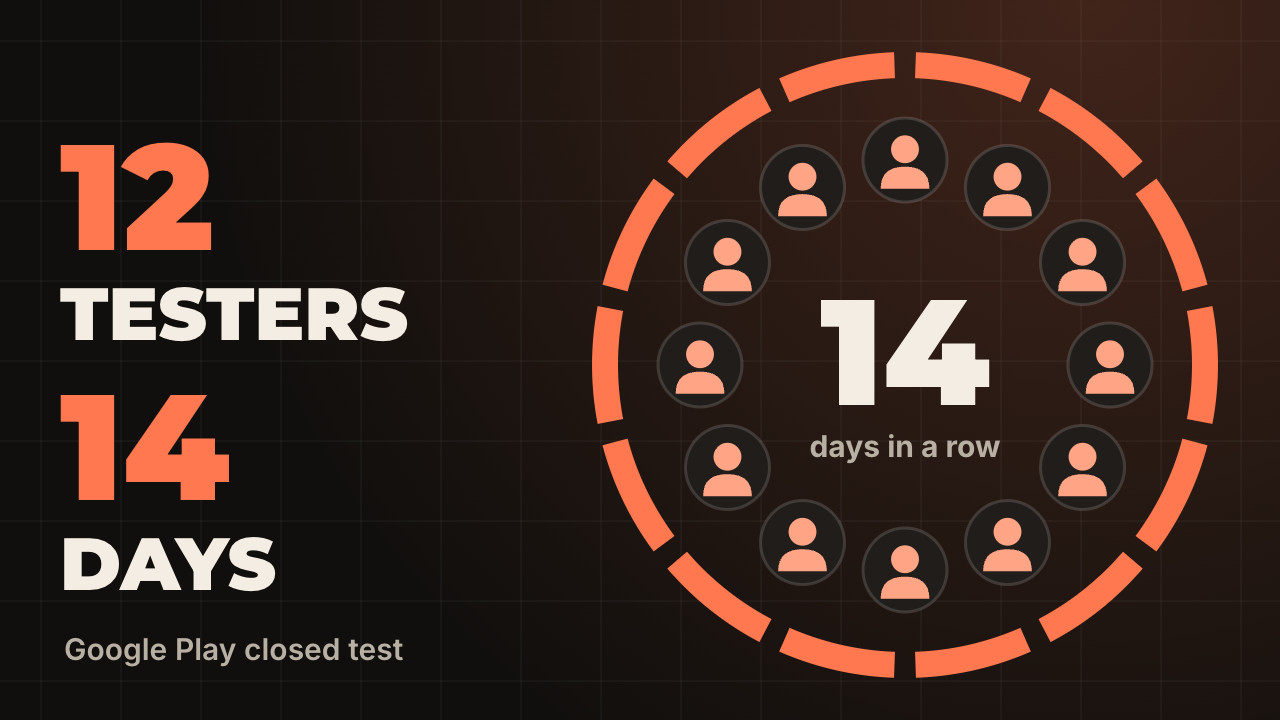
Do you need 12 testers for 14 days to publish on Google Play?
Only if your Play Console account is a personal account created after November 13, 2023. For those accounts, Google's help page says you must run a closed test with at least 12 testers who stay opted in continuously for 14 days, and only then can you apply for production access. That is the wording as of November 2026.
The page is written for personal accounts and does not mention organization accounts. Separately, Google's registration page says personal accounts must complete app testing requirements before distributing apps, and that the owner has to verify access to an Android device with the Play Console mobile app before publishing. The registration fee is a one-time US$25. Check which account type you have before you plan around any of this.
We ship Godot games on iPhone and have no game on Google Play yet, so this guide is a reading of Google's rules, not a report from a launch. Everything below comes from the official pages listed at the end.
How does Google count the 14 days?
Per tester, in a row. Google says a tester who opts out and later opts back in needs 14 consecutive days to count. When you apply, at least 12 testers must be opted in, and they must have been opted in continuously for the preceding 14 days. The clock that matters is the one of your latest or least reliable tester, not the day you uploaded.
The animation shows a made-up case with exactly 12 testers. Tester 9 joins on day 3, so that tester reaches 14 days on day 16. Tester 5 leaves on day 4 and comes back on day 6, so the count starts again and finishes on day 19. All 12 are ready on day 19, five days later than the plan said.
Recruit more than 12. Google counts opted-in testers, so every extra person is margin against someone leaving. Tell testers to stay opted in for the full 14 days, even after they have played what they wanted to see.
How do you add testers to a closed test?
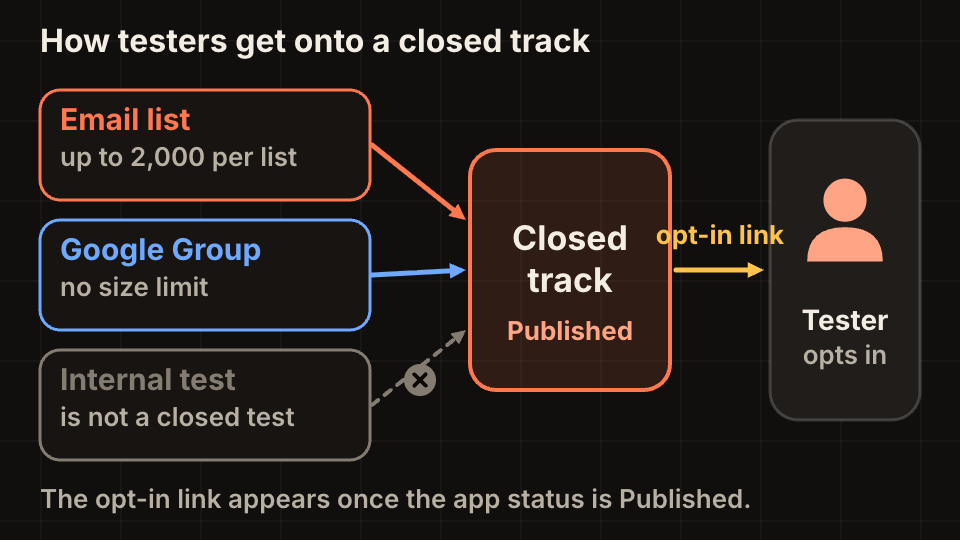
Testers need a Google Account or a Google Workspace account. In Play Console you add them as email lists: up to 200 lists per developer account, up to 50 lists per track, and up to 2,000 testers per list. For bigger groups use a Google Group, which has no size limit, but people must join the group before they opt in.
Each tester then opens the opt-in link and joins. Google says the link only shows when the app status is Published, so a draft or an app pending publication has none. Until testers can opt in, the 14 days cannot start.
The internal test track takes up to 100 testers per app, but it is not the closed test that the requirement names. Use it for your own team and quick checks, and use the closed track for the 12.
How long does it take from first upload to production?
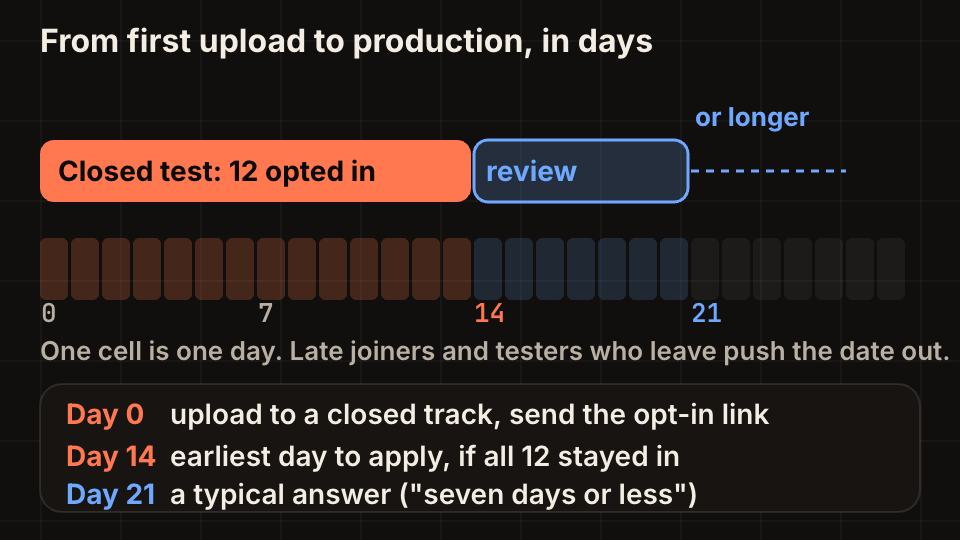
At least 14 days of testing, plus Google's review of your production access application. Google says that review usually takes seven days or less but can occasionally take longer. So plan on about three weeks from the day testers can opt in, and more if anyone drops out. The strip is drawn to scale, one cell per day.
If you have a release date, start the closed test as soon as the build is stable enough to play for two weeks. Do not wait for final art. Use the waiting time for the other Play Console setup: the store listing graphics, the Data safety form, and the target API and bundle requirements.
What does Google ask when you apply for production access?
On the Dashboard in Play Console you click Apply for production. The form has three parts, according to Google's help page:
- About your closed test: how easy it was to recruit testers, whether testers used all the features, whether their usage matched what you expect in production, and a summary of the feedback and how you collected it.
- About your app or game: the target audience, what it offers players, and an estimate of first-year installs.
- About production readiness: what you changed because of the closed test, and how you decided the app is ready.
How do you find 12 people who will actually play?
Google lists two reasons it may ask you to keep testing: fewer than 12 opted-in testers, or insufficient tester engagement. A tester who opts in and never opens the game helps neither. Ask for people who play your genre: your Discord or newsletter, itch.io followers, other developers who test each other's builds, friends who own an Android phone.
Give each tester a small job, not just a link: play for ten minutes on three different days, finish the first level, and answer five questions. Keep a sheet with one row per tester, the builds they played and what they reported. That sheet is also your material for the production form, because the questions ask how testers used the app and what changed afterwards. If you use iPhone betas too, the TestFlight guide covers that side.
What goes wrong most often?
These are the mistakes the rule makes easy:
- Recruiting exactly 12 people, so one departure restarts the plan.
- Counting from the upload date instead of from the day testers could opt in.
- Testers uninstalling or opting out to clean up their phone mid-test.
- Waiting for the test to end before preparing the store listing, Data safety form and content rating, which then takes another week.
- Uploading a build that misses the current target API level, so the release cannot go out even after approval.
Questions people ask
- Does the 12 testers for 14 days rule apply to organization accounts?
- Google's help page names personal accounts created after November 13, 2023 and does not mention organization accounts. Check what Play Console shows for your own account.
- Can you apply for production access before 14 days have passed?
- No. When you apply, at least 12 testers must be opted in and must have been opted in continuously for the preceding 14 days.
- How long does Google take to review a production access application?
- Google says the review usually takes seven days or less, but can occasionally take longer.